Game development
People play a game because it’s fun. It earns its value when they remember the brand. We work with you from idea to prototype, and from prototype to the store.
Scope
What we cover
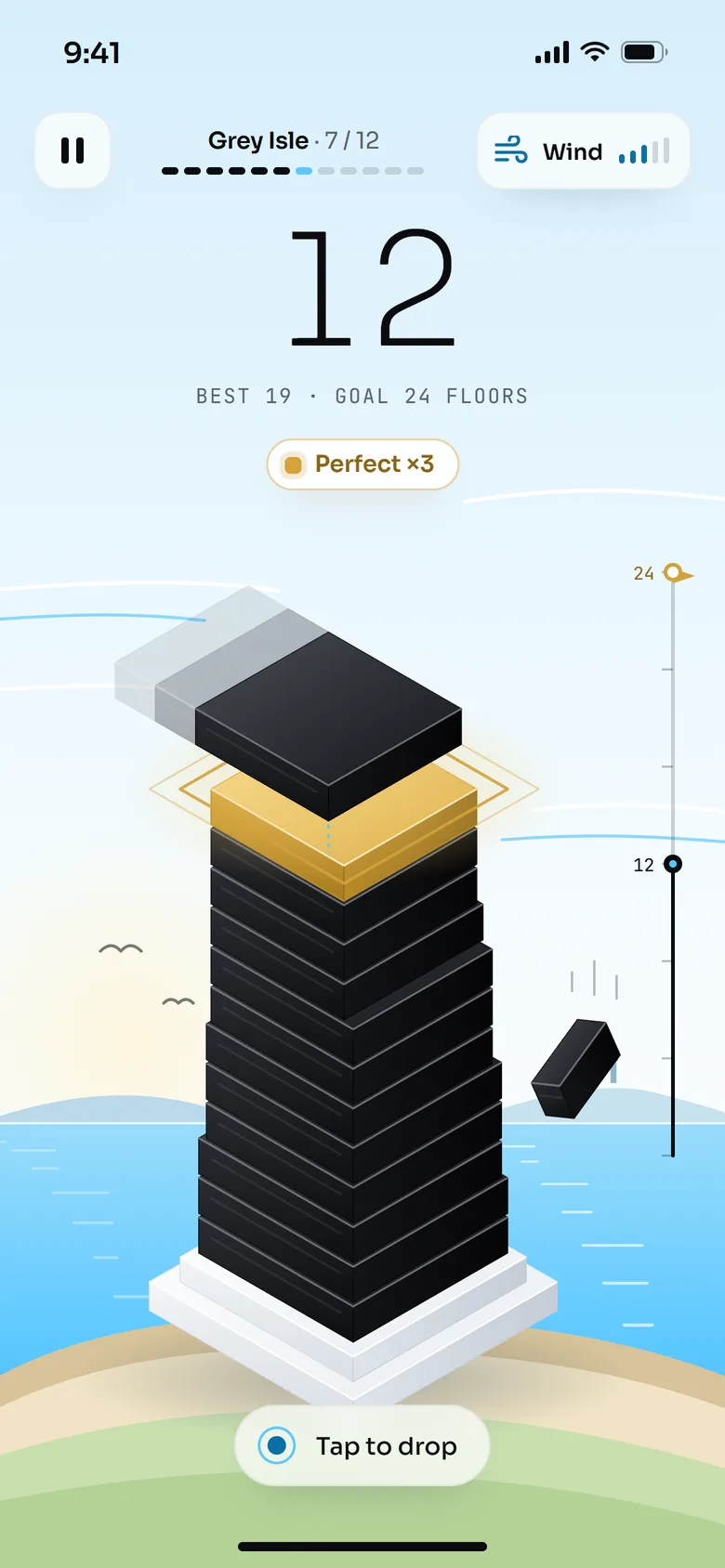
We first build a game as an idea you can play: one core loop, clear controls and a reward that brings players back. We develop for mobile and web with the Godot engine, and make every part of the game, from its characters to its sound, in the same team. Our own tower game that plays in the browser, Build the tower, was made the same way.
Mobile games
We develop iOS and Android games played in short sessions and controlled with one hand. We also take on the release, from the store page to the first update.
- iOS and Android builds
- Store images and description copy
- Godot project files and source code
- Launch and release notes
Web and campaign games
We make HTML5 games that open in the browser with nothing to install and are shared with a link. They embed in your campaign page and run just as smoothly on phones and desktops.
- HTML5 game build
- Embed code for your site
- Leaderboard and share card
- Play and completion metrics
Gamification
We add a layer of points, badges, streaks and quests to your app or campaign. We balance the rewards so they bring users back without wearing them out.
- Points and rewards design
- Badge and quest designs
- UI components
- Rules and balance table
Prototype and game design document
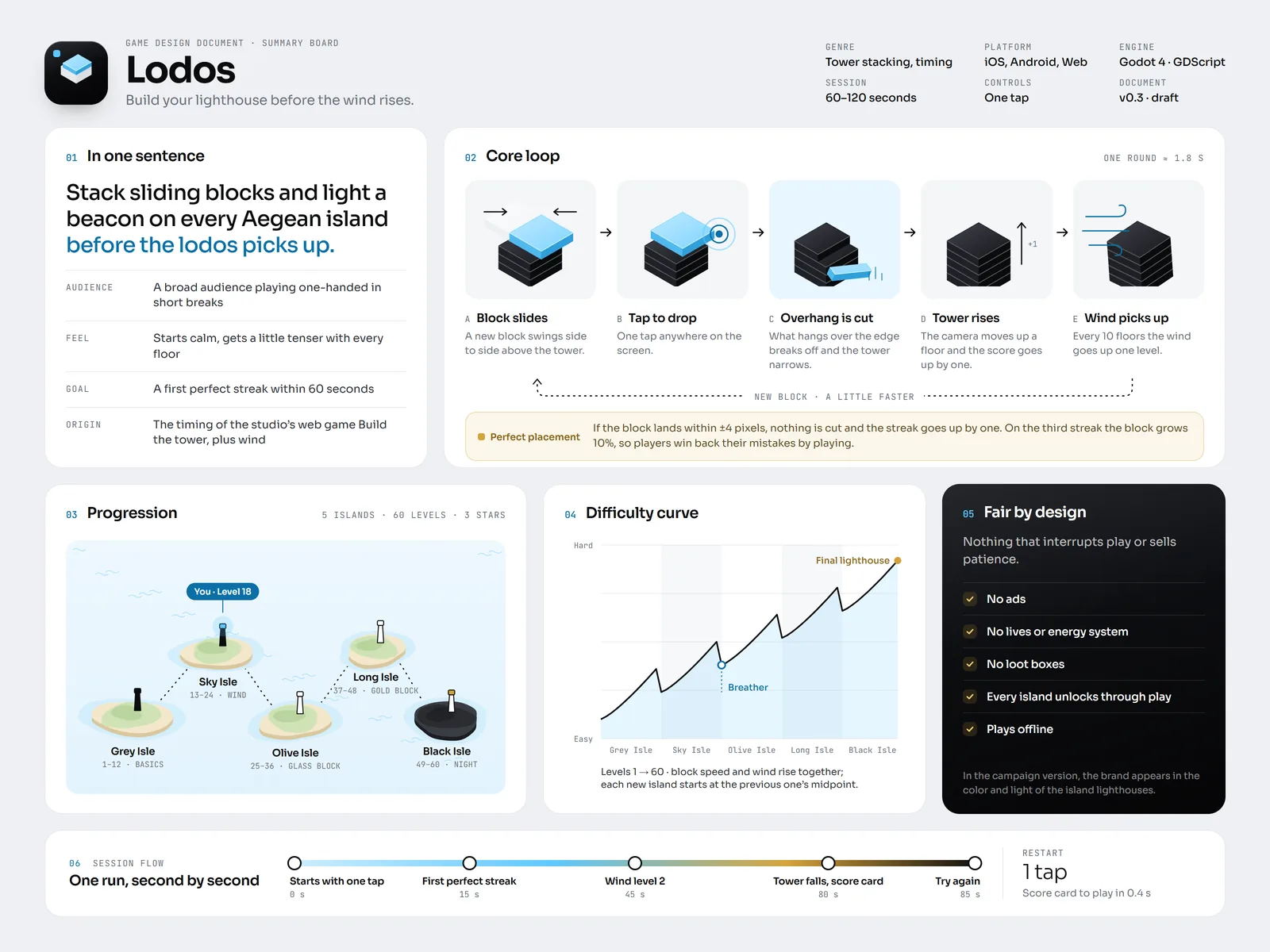
We find out whether an idea is fun with a playable prototype, before committing a big budget. Then we pin down the rules, progression and scope in the game design document.
- Playable prototype
- Game design document (GDD)
- Core loop and progression diagram
- Scope and roadmap
Character and world art
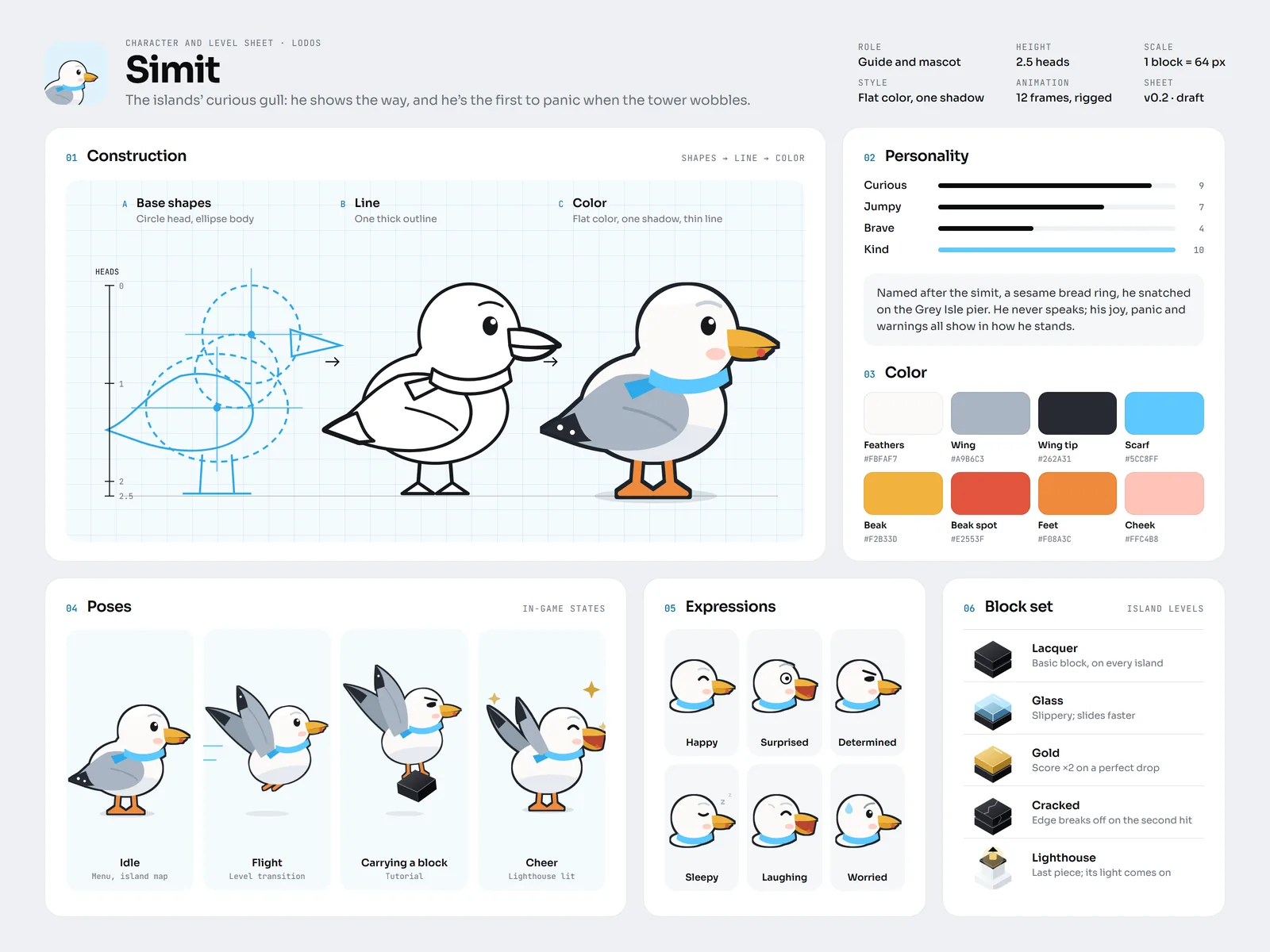
We draw the characters, places and interface language that carry the game’s spirit. Every piece, from 2D sprites to 3D models, is prepared to work inside the game.
- Character design and pose sheets
- Animated sprites or 3D models
- Level and environment art
- UI and icon set
Development in Godot
We develop with the open-source Godot engine, with no license fees or revenue share, and all of the code is yours. We can also join your existing Godot project as a team.
- GDScript source code
- Scene and system architecture
- Performance and device testing
- Developer documentation
Porting and live ops
We port your existing game to new platforms and add new levels and events to your live game. We monitor crash reports and player behavior and plan updates around them.
- Builds for new platforms
- Season and event content
- Crash and performance reports
- Update schedule
Examples
The kind of work we ship
Concepts we designed in the studio to show what work in this area looks like. Client names and data are examples.
Try it
Let us show you instead
We built this small piece as an example of the service. Play with it for a bit, then let’s talk about what we could build for you.
See the other eight demosGame engine
These games were made with Godot.
Godot is an open-source game engine with no license fees; one project ships to desktop, mobile and the web. The games below aren’t ours. They show what the engine can carry. We build your game with the same engine and the same care.
- Deckbuilder, roguelikeSlay the Spire 2Mega CritSee it on Godot’s showcase
- Arena action, rogueliteBrotatoBlobfishSee it on Godot’s showcase
- Mining and defenseDome KeeperBippinbitsSee it on Godot’s showcase
- Open-world monster RPGCassette BeastsBytten StudioSee it on Godot’s showcase
- Suspense, tabletopBuckshot RouletteMike KlubnikaSee it on Godot’s showcase
- Action, rogueliteHalls of TormentChasing CarrotsSee it on Godot’s showcase
- Detective, puzzleThe Case of the Golden IdolColor Gray GamesSee it on Godot’s showcase
- Narrative, adventureUntil ThenPolychroma GamesSee it on Godot’s showcase
Game and studio details are from Godot’s official showcase (godotengine.org/showcase); all rights belong to their makers.
Process
How it runs
Idea and player
We talk about who the game is for, when they’ll play it and for how long. This is where we decide where and how your brand shows up in the game.
Prototype
We make the core loop playable with gray boxes and no decoration. If it isn’t fun, we change it before moving on to visuals.
Design document and art
We write the rules, progression and scope into the document, and draw the characters, the world and the interface.
Production and testing
We add the levels, sound and interface to the game, play it on different devices, and tune the difficulty and balance.
Launch and updates
We publish the game to the store or your site, and plan new content and fixes based on player data.
Why Gosedu
Working with us
Playable before it grows
Every game starts with a gray-box prototype. The budget goes into an idea that has already shown it’s fun.
The code and license are yours
Godot is open source, so you pay no license fee or revenue share for the engine. We hand over all of the project files.
Art, sound and code in one team
The people who draw the character work at the same table as the people who code the game. The visual language stays true to how the game feels in your hands.
Tools we use
- GodotGame engine
- GDScriptGame code
- Blender3D models and animation
- AsepritePixel art and sprites
- KritaConcept art
- FigmaUI and flow design
- FMODInteractive audio
- SupabaseLeaderboards and player data
FAQ
Common questions
Why do you use Godot?
Godot is an open-source, lightweight engine, and builds for mobile, web and desktop come from the same project. You pay no license fee or revenue share, and all of the code stays with you. If your project needs a different engine, we’ll tell you plainly during discovery.
What drives a game’s timeline and cost?
The number of levels, the amount of characters and animation, online features and how many platforms the game ships on. The scope is much clearer after the prototype, so that’s when we can put together a far more accurate plan and quote.
How do you bring our brand into the game?
Instead of putting the logo in a corner, we carry your brand’s world into the game’s rules, characters and colors. Players see the brand as part of the game, not as an ad.
Will the game have ads or in-app purchases?
That depends on your goal. Campaign games usually have no revenue model; for store games, we work out ads, one-time purchases or subscriptions with you in a way that doesn’t wear players out.
Who updates the game after launch?
We can keep it going if you like: new levels, events, OS compatibility and bug fixes. If you’d rather continue with your own team, we hand over the complete source code and documentation.
Let’s start
Let’s talk about your project.
Tell us in a few sentences what you want to build, and we’ll come back with a roadmap and a quote.